




Are you looking to buy a home and make some extra income through real estate investments? Then investment property loans could be the perfect solution for you.
Whether it’s your first rental property or you’re adding to your real estate portfolio, finding the right investment property loan is an essential first step. We’ll show you how investment property mortgages work, the types of financing options available, and what rules you must follow for a successful fund investment.
Here at Mortgage Marketplace, we’re here to help you navigate through real estate transactions and more. Feel free to call (833) 970-1560 to learn more and get started on building your property investment portfolio today.
Investment property loans finance real estate purchases—specifically properties meant to produce rental income.
Expect higher requirements, including larger down payments, a strong credit score, and full financial documentation to qualify for such a loan.
Qualifications for an investment property loan: at least a 15% down payment and a minimum 680 credit score.
Make sure to have the financial strength to handle upfront costs for investment properties—costs that investment property loans can cover.
Investment property loans are mortgages used to purchase an income-generating property. These loans will have tougher qualifying requirements, higher down payments, and higher interest rates compared to traditional mortgages.
It’s important to note that there is no legal limit to how many investment property loans a buyer can apply for and receive. However, most mortgage lenders will have financing limits, typically limiting borrowers to 10 financed properties. If a conventional investment property loan can’t be acquired, borrowers may want to consider alternative financing options as well when planning.
When it comes to purchasing property for income investment purposes as opposed to residence, an investment property loan can help you afford these properties. Typically, such properties are rented to tenants or held with the expectation that the property value will rise over time. Because these properties are income-producing assets instead of buyers’ residences, they are evaluated differently by lenders and come with their own financing rules.
Fundamentally, investment property loans and primary home mortgages are different. Investment property loans require a down payment of 15-20%, a credit score of 680, and documentation to prove one’s financial stability.
Traditional home mortgages, in comparison, require a 3-5% down payment and a minimum credit score of around 620.
Note: Down payment and credit card requirements will depend on your state, financial situation, and more. Use our Home Affordability Calculator to determine what you can afford and discover your goals.
A conventional loan is a versatile financing option for both single-family and multifamily loan options. It is also the most common type of loan for purchasing investment properties. You can expect higher credit scores and higher down payment requirements—typically a credit score minimum of 620 with 25% down payment or 680 with 15% down payment. Interest rates are also about 0.50-0.75% higher than primary residence mortgages.
Reserve requirements may also be a factor for loan approval, with some lenders, such as Fannie Mae and Freddie Mac, expecting borrowers to have at least six months of capital for loan coverage without income from a property.
In many cases, lenders will also factor anticipated rental income into the loan application process. However, borrowers can strengthen their loan applications by demonstrating their property will generate sufficient income to support loan obligations. As a best practice, it’s recommended to confirm and verify lenders’ licensing status through the NMLS Consumer Access portal.
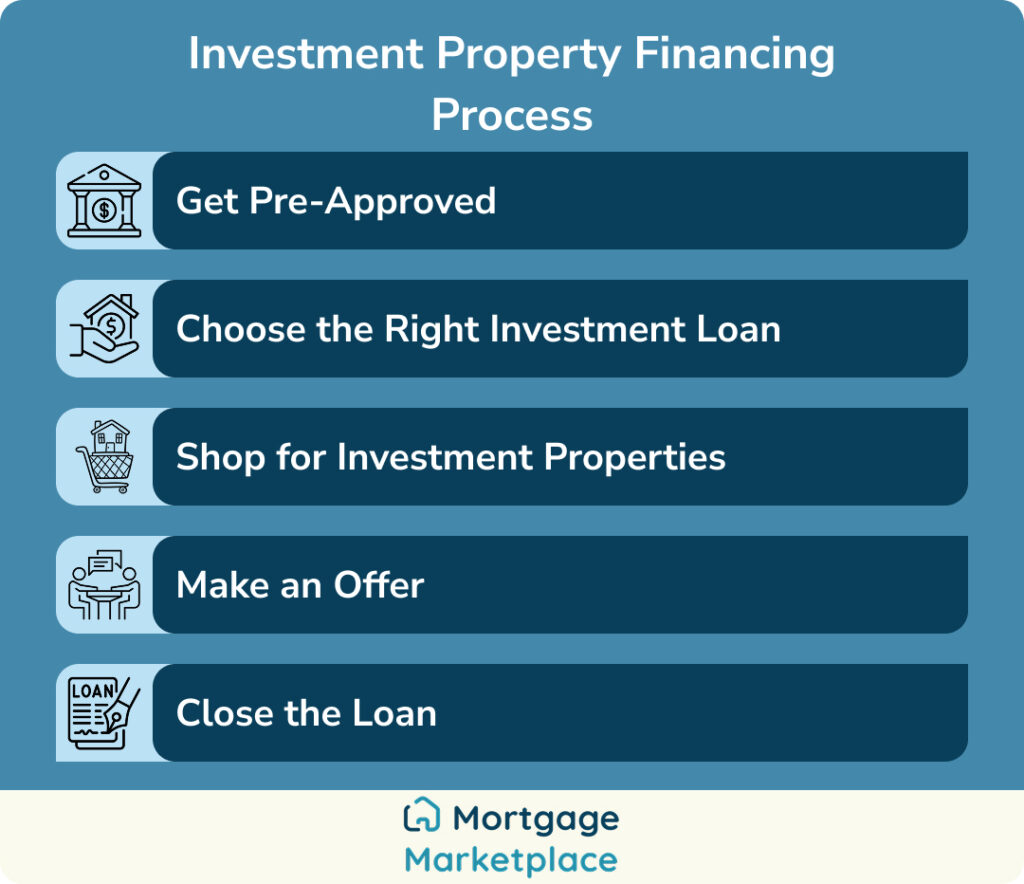
In short, after financial preparation and meeting lender requirements, you can expect to move through the financing process:
Ready for processing? Get pre-qualified today and explore financing options tailored to your investment goals.
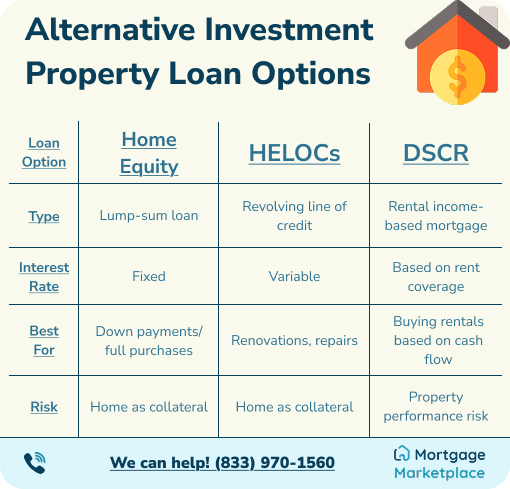
Outside of a conventional mortgage, there are still many ways to secure an investment property loan, thanks to many alternative financing options available for real estate. Take a better look and get familiar with how each loan option can work for you:
Available through the Federal Housing Administration and Veterans Affairs, government-backed loans are limited to primary residences, allowing buyers a home of up to four living units with 0% down payment.
VA loans are limited to eligible active-duty service members, reservists, National Guard personnel, veterans, and qualified surviving spouses. Borrowers must have a 580-620 minimum credit score (exact minimum dependent on property type).
FHA loans, on the other hand, can allow you to purchase up to four units with a credit score of 580 or better alongside a 3.5% down payment. The FHA also has options for those interested in purchasing complexes with five units or more (per lender guidelines and payment requirements).
Home equity loans allow you to access your home equity through a second mortgage so that you can keep an existing low-interest rate while still taking advantage of your home value to fund other investments.
A home equity line of credit (HELOC) can offer a more flexible alternative for investors looking to access capital over time rather than all at once. HELOCs are second liens that turn your home equity into a line of credit. You’ll have to initially make interest payments on the funds drawn before you can put funds back and reuse them during the draw period. Balances will freeze, and interests will be paid for the remainder of the term during the repayment period.
It’s also important to note that HELOCs have variable interest rates, so they can be less predictable than traditional loans, potentially making it more difficult to repay the loan.
Hard money loans are based on the value of the underlying collateral. This option is only used when you can’t qualify for other loans, and if this is your only financing option, experts tend to recommend that investors wait and improve their credit standing.
Bridge loans are a form of temporary financing in real estate transactions used to provide cash flow while securing a more permanent alternative. Homeowners can use this option to pay for a new home while waiting to sell a home.
With cash-out refinancing, the interest rate is lower than that of a home equity loan or HELOC, and the investor has a single monthly payment.
Debt service coverage ratio (DSCR) loans are ideal for investors looking to qualify based on a property’s income potential instead of their financial metrics. So, when dividing all the money you receive from the property each month by the amount paid for home loans and maintenance, investors should receive property income of some sort.
Interest rates for investment properties are usually higher because of the greater risk lenders take when financing investment homes. Mortgage payments, even when properties are vacant or undergoing repair, must be paid by investors, which in turn increases the likelihood of payments defaulting compared to primary residence financing.
As of November 2025, investment property mortgage rates average around 0.5% to 1% higher than rates for primary residences.
When it comes to finding the ideal mortgage rate for an investment property loan, borrowers should review multiple lenders, consider options for paying discount points to reduce long-term costs, and maintain a strong credit score to qualify for the best terms. In addition, research tools offer valuable insights into current market trends, property listings, and mortgage offerings that help investors make informed decisions based on location-specific data.
Ready to compare loan options? Use our free mortgage calculators to estimate payments, compare investment scenarios, and find the right financing strategy for your property.
Investment property loans are great tools for bringing in short-term revenue and long-term wealth alike, generating passive income and expanding the playing field for your capital ventures.
Much like any other business venture, investment property loans come with their own set of challenges—stricter lending requirements, higher interest rates, and market fluctuations are major factors. So, whether it’s your first rental or adding to an existing portfolio, making the right financial decisions ought to be backed with proper planning and preparation.
At Mortgage Marketplace, you can make your investment property financing simple. We’re here to help you learn and make informed decisions when navigating through DSCR loans, rate comparisons, home equity strategies, and more. Create your loan strategy with our free mortgage calculators, get pre-qualified today, and move towards building a stronger real estate portfolio.
I appreciate the breakdown of closing costs—it’s something I hadn’t considered before. Great read!

Sammy P
Queens, NY
5/5
Great article! I didn’t realize how important it is to budget for maintenance and closing costs. Very helpful!

Jeremy M
Georgia, MD
5/5
This was super insightful! The tips on saving for a down payment cleared up a lot of confusion for me.

Tania N
Towns, CA
5/5

Investment property loans are mortgages used to purchase real estate, specifically investment properties, rather than a primary residence.
There is no legal limit when it comes to how many investment property loans you can apply for and receive. However, mortgage lenders tend to have financing limits, typically limiting borrowers to 10 financed properties. A borrower’s ability to own more will be mainly determined by their overall financial strength (cash reserves, credit score, ability to manage multiple properties and their debts, etc.).
Yes, you can use a DSCR loan to finance a rental. DSCR loans allow investors to qualify based on a property’s rental income instead of personal income documentation.
Conventional mortgages and DSCR loans are commonly recommended for financing investment homes. However, factors such as credit profile, income situation, and the type of property you plan to finance will all play into your chances of securing your ideal loan.
Effortless Application, Expert Support
From pre-approval to closing, our streamlined process and experienced team make home financing stress-free.
Personalized Plans for Your Needs
Whether it's refinancing, home equity, or a new mortgage, we customize solutions to fit your financial goals.
Clear Rates, No Surprises
We provide competitive rates and full transparency, so you know exactly what to expect at every step.