






Home buying tips

Home Financing with Jumbo Loans and Other Non-Conforming Alternatives

8 min read

If you’re in the market for a mortgage to purchase a home or if cash isn’t readily available, you might want to consider jumbo loans. A jumbo loan mortgage is a non-conforming financing option that’s growing in popularity with rising housing costs.

We’ll break down everything that you and your loved ones need to know about how jumbo loans work, reasons why you might want to consider the option, current trends, alternative financing options, and more.

Quick Summary

Jumbo mortgages are non-conforming loans that exceed conventional lending limits and aren’t backed by Fannie Mae or Freddie Mac.

Because jumbo loans are non-conforming, they allow buyers to borrow amounts higher than average conventional loans.

Most lenders want a credit score of 720+, a low DTI ratio, a large down payment, and extensive proof of cash reserves.

Jumbo loans can be used to finance properties meant to be primary residences, vacation homes, second homes, and investment properties of up to four units.

Discover what you qualify for

let us guide you every step of the way!

What Are Jumbo Loans?

In short, jumbo loans, also known as non-conforming loans, are mortgages that exceed conforming loan limits. The Federal Housing Finance Agency is responsible for setting the rules for the type of mortgages that organizations like Fannie Mae and Freddie Mac can purchase. Typically, jumbo loans are taken out for luxury and high-cost properties in expensive markets. 

However, like most conforming conventional loans, jumbo loans are available with a variety of terms and repayment schedules.

How Do Jumbo Loans Work?

Lenders tend to take the risk with jumbo loans, so they are often underwritten manually. A financial expert will be responsible for reviewing a borrower’s credit report, assets, and bank statements to determine whether the loan can be afforded. And despite their non-conforming status, borrowers can get these mortgages at fixed or adjustable rates.

If you’re still planning your homebuying journey, check out our new house checklist to help you and your loved ones stay organized and prepared.

Take your first step

It only takes 2 minutes to find out what you qualify for.

A graphic of a laptop with the Mortgage Marketplace survey on it. It has the buttons for "Home equity", "Refinance", and "Buy a home"

Jumbo Loan Amounts and Qualification Thresholds

In most parts of the US (limits vary by county level), the FHFA has set the conforming loan limit for one-unit properties to $832,750 to $1,249,125. A mortgage is considered a jumbo loan if it exceeds these limits in its respective counties.

How To Qualify for a Jumbo Loan

In general, jumbo loans have stricter requirements than conventional loans. Lenders may require an appraisal to confirm that it’s worth paying the listed amount with the jumbo mortgage. And this is just one of many qualification requirements to receive a jumbo loan.

Down Payment Expectations

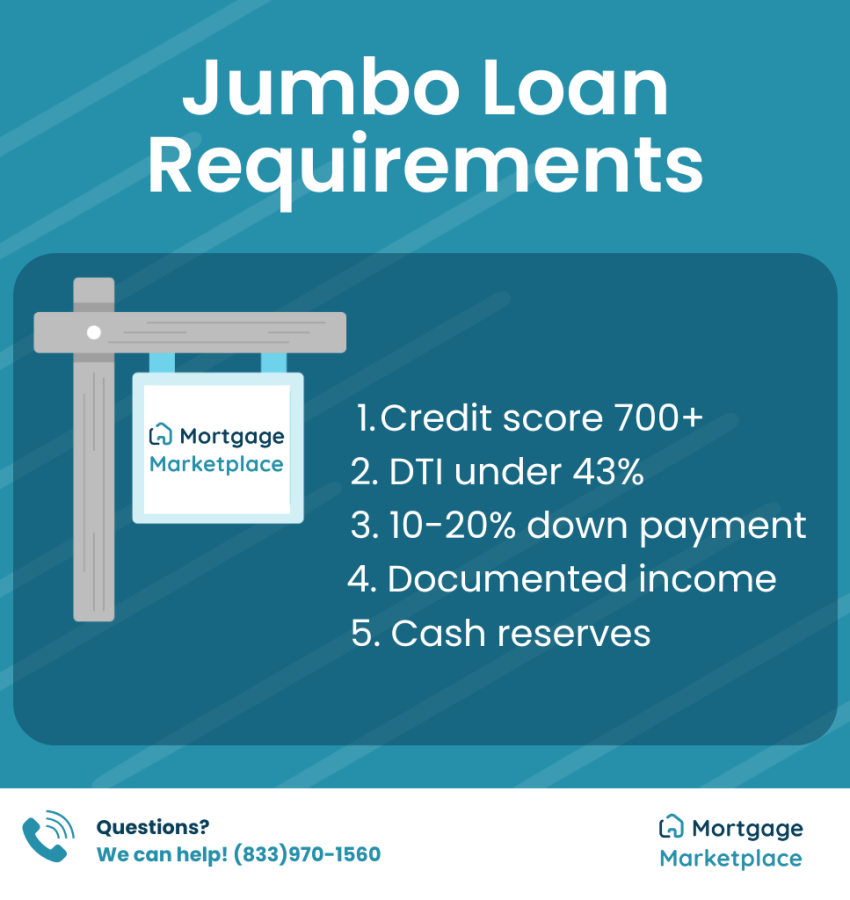
For jumbo loans, expect a higher down payment. Whether you tap into a conforming loan or a jumbo mortgage, a down payment is going to be required. Depending on accompanying factors, borrowers may need to put down 15-40% of a property’s purchase price for jumbo loans (conforming loans require at least 3% for a purchase).

Credit Score Requirements

Most lenders do not accept credit scores lower than 700, and many jumbo loans are given to borrowers with a credit score of 720 or more. For comparison, 620 tends to be the minimum score for borrowers seeking conforming mortgages.

Debt-to-Income Ratios & Proving Cash Reserves

Many lenders for conventional loans seek rates no higher than 43%—but for jumbo loans, borrowers should keep the figure below 36% to increase the chances of loan approval.

For jumbo mortgages, lenders request bank statements to prove that you have six to 30 months of expenses in reserve for loan approval, depending on the lender.

How Much Equity Works for You?

Slide to choose your amount and let’s get started!

10k
10k
500k
See my options

Comparing Jumbo Loans

Conventional Loans

When comparing the two loan types, the main difference is the loan amount each option offers. Fannie Mae, Freddie Mac, and the FHFA (their regulator) set a maximum amount for loans they buy from lenders yearly, and affect the limits for both conforming and non-conforming loans. For conforming loan limit values, maximums are increasing to $832,750 (for single-unit properties) according to the FHFA.

In comparison, jumbo loans have loan maximums of up to several million dollars. Additionally, conforming loans also require the following:

  • 3% – 20% down payment
  • 620 minimum credit score
  • 50% DTI ratio maximum
  • Up to six months of cash reserves
  • Less or equal to 97% loan-to-value (LTV) ratio for fixed-rate loans
  • Less or equal to 95% LTV ratio for adjustable-rate loans

A conventional mortgage is your best option if you are looking to purchase a home that falls within conforming loan limits, due to lower interest rates and overall less stringent requirements.

FHA Loans

Federal Housing Administration (FHA) loans are government-backed home loans insured by the FHA. This reduces lender risk should borrowers default on a loan, allowing lenders to offer more relaxed eligibility requirements in some areas. In general, these are the requirements in question for FHA loans:

  • 580 minimum credit score for 3.5% down payment eligibility
  • 500 – 579 minimum credit score for 10% down payment eligibility
  • Less than or equal to 50% DTI ratio (some borrowers still qualify above 50% DTI ratio)
  • Appraisal and general safety inspection of the property to ensure that it meets appropriate property standards
  • Mandatory FHA mortgage insurance regardless of the down payment amount

Consider all the requirements for FHA loan approval before deciding whether it’s best for your financial goals. Because, while prospective buyers may be attracted to FHA loans’ lowered credit score and down payment requirements, the heightened property standards may limit your home search.

USDA Loans

USDA home loans are zero-down-payment mortgages offered to rural property owners and home buyers. In addition to having no down payment requirements, USDA mortgages typically have lower rates than conventional loans and offer multiple programs for home financing.

VA Jumbo Loans

If you’re a qualifying US military veteran, active service member, or surviving spouse, then you may be able to apply for and access a VA loan. With the loan, you’ll be able to finance high-value homes with more flexibility and without a maximum loan limit.

Qualifications for VA Jumbo Loan Approval

 Requirements vary from lender to lender. However, unlike other loan types, to be eligible for a VA loan, you or your spouse must meet the minimum service requirements set by the Department of Veteran Affairs (VA), which include one or more of the following:

  • Serving 90 consecutive days of active service during wartime
  • Having served 181 days of active service during peacetime
  • Having six years of service in the National Guard or Reserves
  • Having served 90 days (at least 30 of those days consecutively) under Title 32 orders
  • Be the spouse of a service member who died while serving or died from a service-connected disability

You will also need a valid Certificate of Eligibility in addition to meeting lenders’ loan application standards, which include a minimum credit score of 620. Veterans with full VA loan entitlement do not need a down payment for a jumbo loan, regardless of the loan amount.

Property and Appraisal Standards

Most property and appraisal requirements for all VA loans apply to VA jumbo loans: the home must be your primary residence, and it must pass basic inspections for safety and soundness.

The VA Jumbo Loan, Funding Fees, and Closing Costs

The VA funding fee is a one-time payment that the veteran/service member/survivor pays on a VA-backed or VA direct home loan, including VA jumbo loans. This fee helps lower the cost of the loan for US taxpayers since the VA home loan program doesn’t require down payments or monthly mortgage insurance. 

So, if you’re using a VA home loan to purchase, build, renovate, or repair a home or to refinance a mortgage, you will need to pay the VA funding fee unless certain requirements are met. With that said, a VA funding fee does need to be paid if any of the following are true for the borrower:

  • They’re receiving VA compensation for a service-connected disability
  • They’re eligible to receive VA compensation for a service-connected disability, but they’re receiving retirement or active-duty pay instead
  • They’re receiving Dependency and Indemnity Compensation as the surviving spouse of a veteran
  • They’re a service member who’s received a proposed or memorandum rating before the loan closing date that says you’re eligible to get compensation because of a pre-discharge claim
  • They’re a service member on active duty who, before or on the loan closing date, provides evidence of having received the Purple Heart

Closing costs will vary based on factors such as loan amount, property location, lender-specific fees, VA funding fee status, and whether the buyer will be paying for the real estate professional. 

Still have questions about which loan option is right for you? Get pre-qualified today and explore financing options tailored to your investment goals.

Pros and Cons of Jumbo Loans

As with every other type of loan, there are advantages and disadvantages when using a jumbo loan. Understanding both sides of the coin with these high-value loans is essential to help you and your loved ones make the right choice for your current financing situation.

Pros

A graphic of a rounded green bar.
  • Higher loan amounts
  • Similar interest rates to conforming loans
  • Numerous jumbo loan options

Cons

A graphic of a rounded, red bar.
  • Stricter credit score requirements (~720 or better)
  • Higher closing costs and origination fees
  • Appraisal and property inspection requirements can limit market options
  • Extensive financial documentation required
  • Limited lender availability for jumbo loans

Can I Refinance a Jumbo Loan?

Due to their high loan amounts, jumbo loans can be challenging to refinance compared to conventional loans. Much like the initial application process, there are strict requirements for the jumbo loan refinancing process. 

Lenders look for a high credit score, a good DTI ratio, and proof of cash reserves. Additionally, documents such as two years’ worth of annual tax returns, recent pay stubs, bank statements from the past 60 days, and additional documentation of any other income will be required when applying for jumbo refinancing.

Use our Mortgage Calculator to compare refinance scenarios and monthly payments.

Final Thoughts

Jumbo loans can be a great option for buyers in high-cost markets by providing access to the financing they need. However, it’s important to note that to access them, buyers need to expect and prepare for stricter eligibility requirements and higher borrowing costs.

Want to learn more? Here at Mortgage Marketplace, we’ve got you covered. Start your application here today and discover how jumbo mortgages can help you take the next step to purchasing a home.

Qoutation Mark

I appreciate the breakdown of closing costs—it’s something I hadn’t considered before. Great read!

Qoutation Mark

Great article! I didn’t realize how important it is to budget for maintenance and closing costs. Very helpful!

Qoutation Mark

This was super insightful! The tips on saving for a down payment cleared up a lot of confusion for me.

FAQ

Are jumbo loans non-conforming?

+

Yes, jumbo loans are non-conforming because they exceed the loan limits for conventional conforming loans.

What are the downsides of a jumbo loan?

+

The downsides of a jumbo loan include stricter credit score requirements, higher closing costs and origination fees, mandatory appraisal and property requirements, extensive financial documentation, and limited lender availability.

Does the VA offer jumbo loans?

+

Yes, the VA offers jumbo loans to prospective homebuyers who meet service and credit requirements.

How can I apply for a jumbo loan?

+

To qualify for and apply for a jumbo loan, you’ll need the following: 15% - 40% down payment minimum, a 720 minimum credit score, no more than a 36% DTI ratio, and extensive documentation to prove you have anywhere from six to 30 months worth of expenses.

What’s the difference between a jumbo loan and a regular loan?

+

“Regular loans” may refer to a “conventional loan”. When compared to conventional loans, jumbo loans offer higher loan limits—amounts that exceed conventional loan limits—(which make them “non-conventional”) and may come with stricter qualifications.

Why Choose My Mortgage Marketplace?

Process icon representing simplified mortgage application

Simplified Process

Effortless Application, Expert Support

From pre-approval to closing, our streamlined process and experienced team make home financing stress-free.

Solutions icon representing customized mortgage options

Tailored Solutions

Personalized Plans for Your Needs

Whether it's refinancing, home equity, or a new mortgage, we customize solutions to fit your financial goals.

Transparency icon representing clear mortgage rates

Transparent Experience

Clear Rates, No Surprises

We provide competitive rates and full transparency, so you know exactly what to expect at every step.